
The Delphi Murders Roblox Video (THE SWATTING ATTEMPT)
Adrienne and I are Falsely Reported for Possession of CSAM

INCIDENT REPORT
Recently, Adrienne and I were the targets of multiple false and malicious reports accusing us of sharing illegal content (CSAM) —a claim that was thoroughly investigated and completely disproven by law enforcement. This kind of harassment, called “swatting,” is a serious and dangerous attack that wastes crucial police resources and threatens innocent creators like ourselves.
We need your help to fight back.
Please join us in speaking out against this abuse:
If you see suspicious or false reports and statements about content creators, report them to the platform (YouTube, NCMEC, or others).
Share this article to raise awareness about how dangerous and harmful false reporting can be.
Support responsible, fact-based discussions rather than spreading rumors or misinformation.
If you have experienced similar harassment, consider sharing your story with us to help shine a light on this growing problem.
Together, we can protect each other, preserve honest dialogue, and ensure law enforcement resources are used for real threats—not targeted harassment.
The National Center for Missing and Exploited Children (NCMEC) operates the CyberTipline as a centralized system for the public and internet companies to report suspected online child exploitation. NCMEC's primary role is to serve as a conduit, reviewing, categorizing, and routing these tips to the appropriate Internet Crimes Against Children (ICAC) task forces for investigation.
Filing false cyber tip reports with the Internet Crimes Against Children (ICAC) Task Force as part of a harassment campaign is a serious crime. Submitting knowingly false information to law enforcement can lead to criminal charges, including filing a false report, obstruction of justice, and criminal harassment. When done repeatedly or with the intent to harm someone, it may also be considered stalking under state or federal law. These actions not only waste law enforcement resources but can seriously damage the lives of innocent people. In addition to criminal penalties, the person filing the false reports may also face civil lawsuits for defamation or emotional distress. Law enforcement agencies treat this kind of abuse very seriously and will take legal action to stop it.
The Flow of a CyberTip
The relationship is a streamlined reporting process that connects tech companies and the public to the local and regional law enforcement agencies equipped to handle internet crimes.
Reporting: Suspicious online activity is reported to the CyberTipline. Reports can come from the public via the tip line's website or hotline, or from electronic service providers (ESPs), who are legally mandated to report discovered child sexual abuse material (CSAM).
Analysis by NCMEC: NCMEC analysts review and triage the tips. They perform an initial assessment, prioritize tips based on severity and urgency, and work to identify the geographical location associated with the reported activity.
Distribution to ICAC: NCMEC makes the cyber tips available to the relevant law enforcement agencies. For reports in the United States, this is typically the ICAC task force that has jurisdiction over the incident's location.
Investigation by ICAC: The designated ICAC task force receives the tip from NCMEC and initiates an investigation. The task force may handle the case themselves, or if the case is more local in nature, forward it to a local affiliate police agency for action.
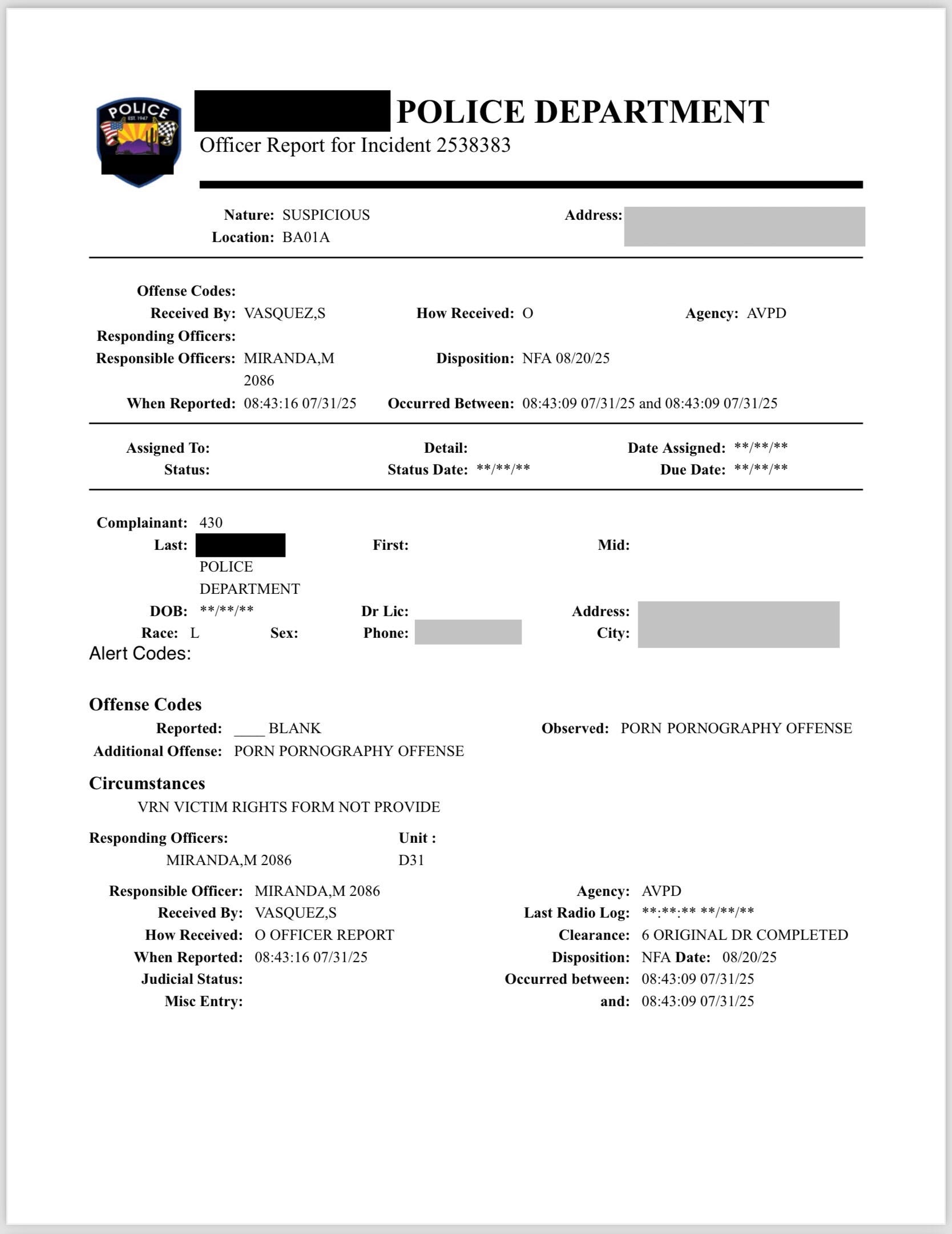
This was likely an attempt at swatting, a dangerous and growing form of harassment where someone makes a false report to law enforcement to trigger an aggressive response, often a SWAT team, at the victim’s home. While traditional swatting involved fake bomb threats or hostage situations, it’s now expanding to include false cyber tips, especially targeting YouTubers, podcasters, and other online creators. These attacks are designed to intimidate, humiliate, and harm the victim, exploiting the seriousness of crimes like child exploitation to provoke a fast, forceful law enforcement reaction. Swatting doesn’t just put lives at risk — it wastes police resources and undermines real investigations. As this tactic becomes more common, especially in online spaces, law enforcement is taking it more seriously and pursuing criminal charges against those responsible.
This incident is a clear example of targeted swatting through the abuse of the ICAC cyber tip system, a tactic that is becoming increasingly common online. An anonymous individual submitted a false and inflammatory tip to the National Center for Missing and Exploited Children (NCMEC), accusing the creators of the YouTube channels Enlight in the Dark and TheProf© of distributing child sexual abuse material (CSAM). The tip included extreme and inflammatory claims, such as distributing a video depicting the sexual assault and murder of two minors, and attempted to link the creators to CSAM distribution by referencing their discussions of the Delphi murders, a real and emotionally charged case involving the deaths of two young girls.
After a thorough investigation, including direct review of the video and an in-person interview, Detective M. Miranda conclusively determined that no CSAM was present, and that the video in question was an animated reenactment using Roblox characters — not illegal content. The report was officially closed with no further action (NFA) taken and no crime found. This kind of false reporting not only weaponizes child protection systems against innocent people, but also diverts law enforcement from genuine threats. It's a dangerous and malicious use of resources that fits the modern definition of swatting — intended to provoke police contact and public harm — and should be treated seriously both criminally and civilly.
Detective M. Miranda investigated the claims thoroughly. She personally reviewed the video referenced in the tip — an animated Roblox reenactment — and conducted an in-person interview with Adrienne. She confirmed that the video contained no nudity, no real people, and no illegal content, and determined it did not qualify as CSAM under the law. The animation used game avatars to speculate and create a narrative on the events of the Delphi case but did not depict actual minors or sexually explicit content. The other channel, TheProf©, was also reviewed, and while the specific video in question could not be located among over 300 uploads, no evidence of illegal content or CSAM distribution was found. Both creators were found to be engaging in legal, opinion-based commentary about a public case.
The investigation was officially closed on August 20, 2025, with a clear statement in the police report that "no crime was determined." This false report represents a dangerous trend where bad actors exploit the seriousness of child protection systems to intentionally provoke law enforcement responses against innocent individuals, often with the intent to harass, intimidate, or damage reputations — a modern form of digital swatting. These attacks are not only malicious and defamatory, but they also divert critical law enforcement resources away from real victims of exploitation. As these tactics grow more common in the digital space, particularly targeting women, single fathers and independent creators, law enforcement and platforms must treat such false reporting as serious offenses, both criminally and civilly.


SUMMARY
On July 4, 2025, an anonymous individual submitted a false cyber tip to the National Center for Missing and Exploited Children (NCMEC) accusing me — and another creator, Adrienne — of distributing child sexual abuse material (CSAM) through our YouTube channels. The tip falsely claimed that a video shared on Adrienne’s channel and on my Substack account, contained or facilitated the sharing of explicit illegal content related to the Delphi murders. These claims were entirely fabricated.
This report triggered an investigation by our local police departments. We fully cooperated. Detective M. Miranda reviewed all the content in question — including the video that sparked the report. The video is an animated reenactment using Roblox characters and was used to discuss publicly available information about the Delphi murders case. It did not include nudity, real individuals, or any illegal or pornographic material. The officer concluded that “no CSAM was present,” that “no crime had been committed” and the case was officially “closed with no further action” as of August 20, 2025.
CONCLUSION
This false report was not just a misunderstanding — it was a calculated attempt to abuse the child protection reporting system to harass and silence us, a tactic well known as swatting. These tactics are growing more common against independent creators and journalists, especially those covering high-profile or controversial topics. Not only are they dangerous and traumatizing, but they also waste police resources that should be focused on real threats. It is unacceptable that any individuals involved in the Delphi murders case, in any way, would intentionally engage in the abuse and waste of precious law enforcement resources, especially when those resources are designed to save and protect innocent children.
To my community: Thank you for your ongoing support. I will not be intimidated by false accusations or smear campaigns. I will continue to speak responsibly, factually, and ethically about these important issues — and I will protect myself through the appropriate legal channels whenever necessary.
Stay informed. Stay safe.
Prof
Why did you do it to Ariel first